
Umrah Duas: What to Recite During Tawaf, Sa'i and Your Journey
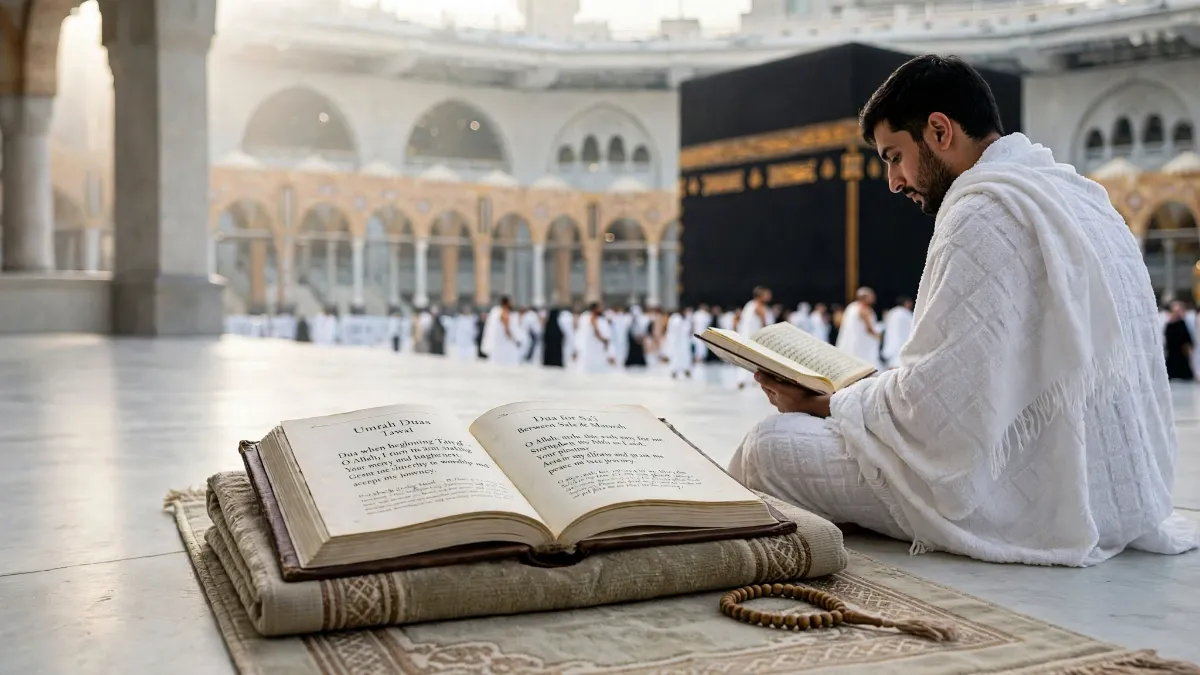
Quick answer: Umrah duas are not a fixed script. Recite the Talbiyah after Ihram. Say Rabbana atina fid-dunya hasanah between the Yemeni Corner and the Black Stone. Recite the Safa and Marwah dhikr. Everything else is personal dua in any language. No separate dua exists for each Tawaf round.
Here is the good news about Umrah duas. You do not need to memorise a long booklet.
A few supplications are specifically reported for Umrah. Everything else is your own dua, in any language.
This guide gives you the Arabic, transliteration and meaning for each one. It also shows what is established and what is optional.
I want pilgrims to arrive prepared, not anxious. If you are still comparing trips, our guide to Umrah packages from the UK explains flights, hotels and costs.
What Duas Should You Prepare Before Umrah?
Prepare three or four authentic duas and a short personal list. A small Umrah dua list beats a long booklet you cannot finish.
Crowds, heat and tiredness make memorising hard. A simple plan removes the pressure.
• Learn the Talbiyah first. You will repeat it many times.
• Learn Rabbana atina fid-dunya hasanah. It is the dua for Tawaf.
• Save the Safa and Marwah dhikr. Keep it in your phone notes.
• Write your personal requests. Use your own language, and keep the list short.
Before you leave home, make a simple dua before Umrah. Ask Allah for ease, safety and acceptance.
Now picture another who knows three duas and a personal list. She walks calmly and speaks from the heart. In my opinion, she has the better Umrah.
Pro Tip: Save one phone note with Arabic, transliteration and meaning on separate lines. Download it offline before you fly.
What to Recite When Entering Ihram and Starting Umrah
Recite the Talbiyah once you make your intention for Umrah. Keep saying it until you begin Tawaf.
TALBIYAH FOR UMRAH
لَبَّيْكَ اللَّهُمَّ لَبَّيْكَ، لَبَّيْكَ لَا شَرِيكَ لَكَ لَبَّيْكَ، إِنَّ الْحَمْدَ وَالنِّعْمَةَ لَكَ وَالْمُلْكَ، لَا شَرِيكَ لَكَ
Transliteration: Labbayk Allahumma labbayk, labbayka la sharika laka labbayk, innal-hamda wan-ni'mata laka wal-mulk, la sharika lak.
Meaning: Here I am, O Allah, here I am. Here I am; You have no partner. All praise, blessings and sovereignty belong to You. You have no partner.
Men usually raise their voices. Women keep theirs low. If you need a ruling on a specific situation, ask a qualified scholar.
The Talbiyah is the heartbeat of the journey to the Haram. If you want every step in order, our guide on how to perform Umrah covers the full sequence.
Dua When Entering Masjid al-Haram and Seeing the Kaaba
Enter with your right foot. Say: Allahumma iftah li abwaba rahmatik. It means, O Allah, open the doors of Your mercy for me.
No specific dua is established for the first sight of the Kaaba. Many pilgrims pause and make personal dua. Step aside so you do not block the path.
Umrah Duas During Tawaf: What to Recite in Seven Rounds
Tawaf has seven rounds, but no dua is assigned to any single round. Say Allahu Akbar at the Black Stone and Rabbana atina between the two corners.
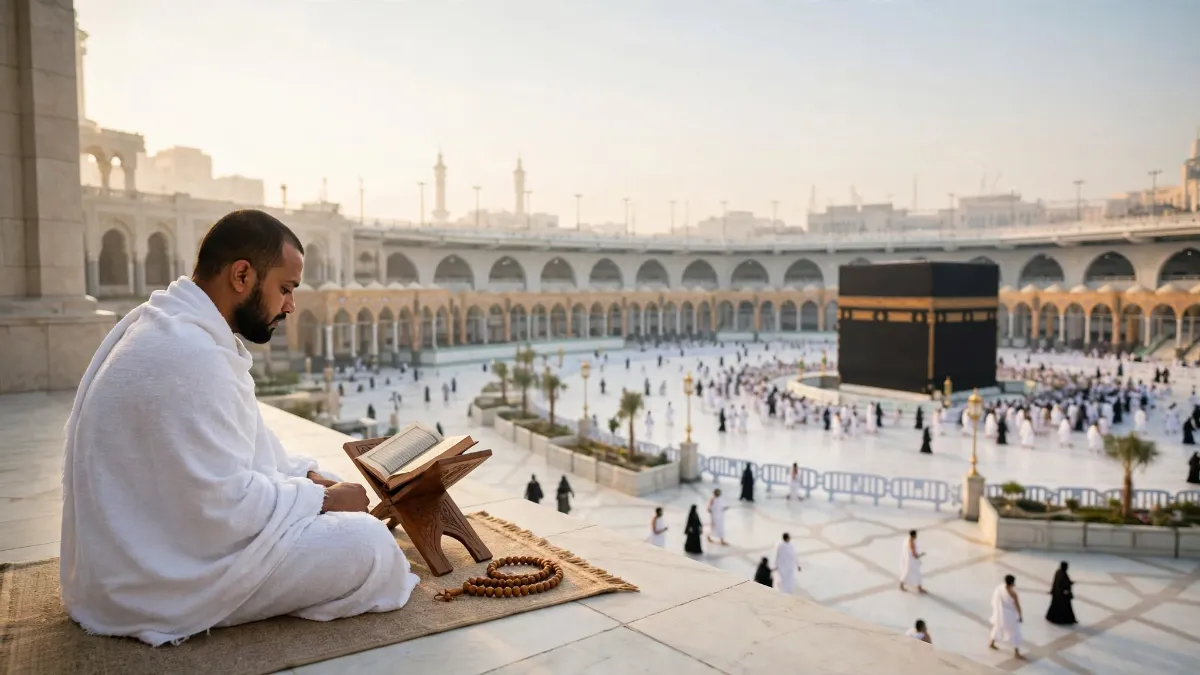
These tawaf duas are short and easy to learn. Beyond them, speak to Allah freely during the seven rounds of Tawaf.
What to Say When Beginning Tawaf
Start in line with the Black Stone. Say Allahu Akbar each time you pass it, as the Saudi government's Tawaf guidance explains.
If you cannot touch the Stone, point towards it with your right hand. Never push through the crowd to reach it.
The Dua for Tawaf Between the Yemeni Corner and the Black Stone
This is the one supplication reported for a set part of Tawaf. It comes from Surah Al-Baqarah, verse 201. The Prophet, peace be upon him, recited it between Rukn al-Yamani and the Black Stone, as recorded in Sunan Abi Dawud.
DUA FOR TAWAF
رَبَّنَا آتِنَا فِي الدُّنْيَا حَسَنَةً وَفِي الْآخِرَةِ حَسَنَةً وَقِنَا عَذَابَ النَّارِ
Transliteration: Rabbana atina fid-dunya hasanatan wa fil-akhirati hasanatan wa qina adhaban-nar.
Meaning: Our Lord, grant us good in this world and good in the Hereafter, and protect us from the punishment of the Fire.
Do You Need a Different Dua for Every Tawaf Round?
No. Scholars at IslamQA explain that no separate supplication is narrated for each circuit.
In my view, round-by-round booklets cause more stress than benefit. Pick a few duas and add your own.
Picture a family with an elderly father in a wheelchair. They agree on one short dua and say it together. Nobody scrolls, and everybody joins.
Pro Tip: Keep your eyes up and your phone away while walking. Memorise a short dua and repeat it.
Common Tawaf mistakes
• Pushing towards the Black Stone and hurting others.
• Stopping in the circle to read a long dua.
• Believing each round needs its own dua.
Hotel distance matters here too. A shorter walk to the Haram leaves you more energy for Tawaf and Sa'i.
What to Recite After Tawaf and While Drinking Zamzam
After Tawaf, pray two rak'ahs, drink Zamzam, then head to Safa. No fixed wording is required for the dua after Tawaf.
1. Pray two rak'ahs where space allows. Do not block other worshippers.
2. Drink Zamzam and make a personal dua for your own needs.
3. Walk towards Safa to begin Sa'i.
Popular dua wordings for Zamzam are often shared online. Without a reliable reference, I would not treat them as fixed formulas.
Pro Tip: Never stop in walkways or prayer routes to read. Step aside first.
Duas During Sa'i Between Safa and Marwah
Sa'i is seven trips between Safa and Marwah. Begin at Safa, end at Marwah, and recite the established dhikr on each hill.
What to Recite at Safa and Marwah
These Sa'i supplications follow the Prophet's pilgrimage, as narrated in Sahih Muslim. Follow this order at Safa:
1. Approach Safa and recite Surah Al-Baqarah 2:158.
2. Say: Abda'u bima bada'a Allahu bih. It means, I begin with what Allah began with.
3. Face the Kaaba. Say Allahu Akbar, then the dhikr below.
4. Make your own dua, then repeat the dhikr. Do this three times.
5. Walk to Marwah. Men jog lightly between the green lights.
6. At Marwah, repeat the dhikr and dua without reciting the verse again.
7. Finish seven trips, ending at Marwah.
DHIKR AT SAFA AND MARWAH
لَا إِلَٰهَ إِلَّا اللَّهُ وَحْدَهُ لَا شَرِيكَ لَهُ، لَهُ الْمُلْكُ وَلَهُ الْحَمْدُ وَهُوَ عَلَىٰ كُلِّ شَيْءٍ قَدِيرٌ، لَا إِلَٰهَ إِلَّا اللَّهُ وَحْدَهُ، أَنْجَزَ وَعْدَهُ، وَنَصَرَ عَبْدَهُ، وَهَزَمَ الْأَحْزَابَ وَحْدَهُ
Transliteration: La ilaha illallahu wahdahu la sharika lah, lahul-mulku wa lahul-hamdu wa huwa 'ala kulli shay'in qadir. La ilaha illallahu wahdah, anjaza wa'dah, wa nasara 'abdah, wa hazamal-ahzaba wahdah.
Meaning: None has the right to be worshipped but Allah alone, without partner. His is the dominion and His is the praise, and He has power over all things. He fulfilled His promise, supported His servant and defeated the confederates alone.
Between the hills, you need no fixed dua. Make dhikr, recite Qur'an or ask for what you need.
Quick Reference: What Is Established and What Is Free
Ihram to Tawaf: Talbiyah — Established Sunnah
Black Stone, each round: Allahu Akbar — Established Sunnah
Yemeni Corner to Black Stone: Rabbana atina fid-dunya hasanah — Established Sunnah
Rest of Tawaf: Any dua, dhikr or Qur'an — Your free choice
Safa and Marwah: Verse, takbir, dhikr and dua — Established Sunnah
Walking between hills: Any dhikr or personal dua — Your free choice
Can You Make Personal Duas in Your Own Language?
Yes. Ask Allah in English, Urdu, Punjabi, Arabic or any language you speak. Allah knows what is in your heart.
The Qur'an reminds us that Allah is near and responds to those who call on Him (Qur'an 2:186). Fixed wordings apply to the reported remembrances. Your personal dua is open.
Picture a grandmother who speaks only Punjabi. She cannot recite long Arabic. She pours out her heart for her children, and I find that deeply moving.
SIMPLE PERSONAL DUA (EXAMPLE)
اللَّهُمَّ اغْفِرْ لِي وَتَقَبَّلْ عُمْرَتِي
Transliteration: Allahumma-ghfir li wa taqabbal 'umrati.
Meaning: O Allah, forgive me and accept my Umrah. Then add: make things easy for my family.
For detailed rulings on prayer or rites, ask a qualified scholar.
Prepare for Your Umrah Journey With Confidence
Umrah duas should help you focus, not worry. You need the Talbiyah, one Tawaf dua and the Safa and Marwah dhikr.
Add personal requests in your own words. This simple Umrah dua guide is enough to begin.
Planning from the UK? Our 7-night 4 Star packages start from £895 per person, as a guide price. The page lists flights, hotels, transfers and visa support.
Final prices change with travel dates, departure airport, flights, hotel availability and category. Room type, number of nights and your Makkah and Madinah split also matter. Check inclusions before you book.
You can explore our Umrah packages, or speak to an Umrah expert on +44 20 3411 1934 for a free Umrah quote.
Frequently Asked Questions About Umrah Duas
Is There a Specific Dua for Each Round of Tawaf?
No. No separate dua is prescribed for each circuit. You can make personal supplications, remember Allah and recite Qur'an throughout Tawaf.
Can I Read Umrah Duas From My Phone?
Yes, you can use your phone as a reference. Keep it brief and step out of the walkway first. Do not let reading distract you or block other pilgrims.
What If I Forget a Dua During Umrah?
Do not panic. Carry on with your worship and make the supplications you know. Forgetting a dua does not mean you must stop your ritual.
Are Umrah Duas Available in English?
Yes. English translations help you understand each meaning. Transliteration helps you pronounce the Arabic until you feel confident.
Do I Have to Recite Arabic Duas During Tawaf and Sa'i?
You can make personal supplications in your own language. For the reported remembrances, learn the Arabic wording where you can. Ask a qualified scholar if you need a ruling on a specific situation.